GradeWithClario
gradewithclario.com ↗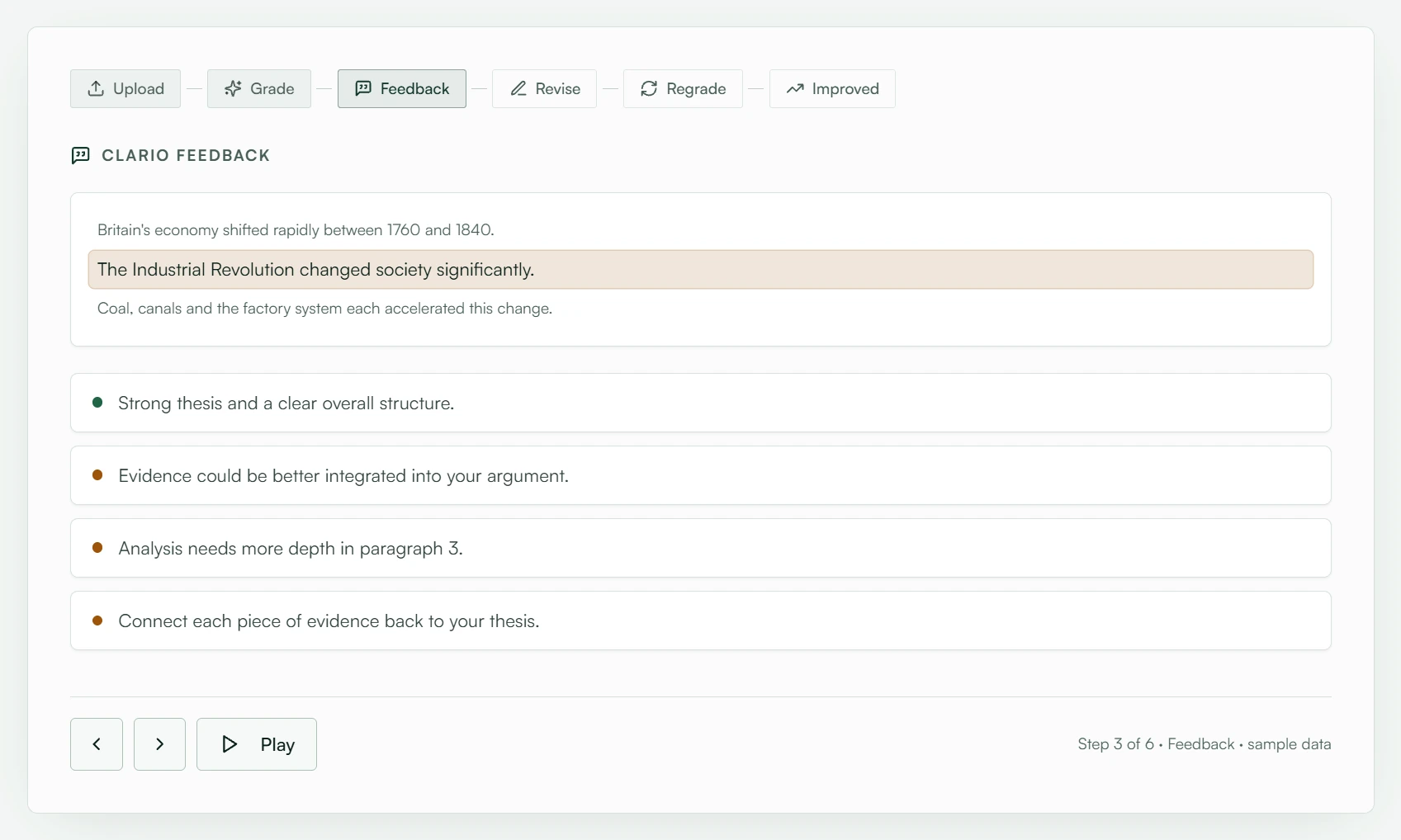
Students hand in work without knowing whether it meets the rubric. The feedback shows up with the grade, after they can do anything about it.
An assignment checker. Upload the work and the rubric, get a predicted grade, inline feedback and a ranked list of fixes, then revise and regrade inside Clario.
Raised a $50K pre-seed for 5% equity. Relaunched in October 2026 as fully free, measuring activation and retention instead of conversion.
My role
I lead product and own the backend. I also decide who builds what, and I split the work by feature instead of frontend vs. backend, so each person owns something end to end on a three-person dev squad.
We run 8-day sprints: four days of building, one day of QA, two days of refinement and bug fixes, and a final day where I validate every ticket against its acceptance criteria.
It started as a tool for teachers
The first version, in August 2025, was a grading assistant for teachers. I built the backend as a FastAPI service with Celery workers. Files went straight from the browser into a private storage bucket, a background job pulled out the text, graded it against the rubric and saved the result, and then the file was deleted. We hosted the data in Canada because student work was going to sit on our servers.
Then we picked students
The product brief I wrote in May 2026 put it this way:
Students submit assignments blind. They invest hours into their work without any reliable way to know whether they've met the rubric criteria, until it's too late to act on the feedback.
Students feel that problem directly, and they can start using a tool tonight without a school signing off. Teachers were a slower sale behind an approval process. So the product became student-first, and we dropped the teacher framing.
How it works
- A student uploads or pastes an assignment, adds the rubric, and can tag the assignment type (essay, report, lab report, reflection).
- Grading runs in a server-side function, so API keys never reach the browser.
- The result is a predicted letter grade and percentage, inline comments, and a prioritized list of fixes.
- With no rubric, it grades against general academic criteria (thesis, structure, evidence, analysis, clarity, grammar) and says so on the results page.
- The student revises in the workspace and regrades. The tagline is "Upload. Improve. Regrade. Repeat."
Decisions and tradeoffs
| Decision | Why |
|---|---|
| Rubric field is optional but always visible | Grading is better with the rubric, but requiring it adds friction for a first try. |
| Free limits of 5 grades a day and 15 a week, enforced server-side | A grade costs about 0.4 cents, so the caps are there to stop abuse, not to protect margin. Failed runs don't count against them. |
| Removed the paid plan completely instead of hiding it | A hidden paywall skews the test. With no paid tier, the honest metrics are activation and retention. |
| A real, not watered-down, free demo | Modelled on GPTZero: paste an essay without signing up and get a real grade with limited detail. One tap to sign in unlocks the rest and keeps the demo grade. |
| Due-date reminders as the retention loop | A student can create an assignment with just a due date, which turns Clario into a deadline tracker that brings them back before they even have a draft. |
| Same model for the demo and the app | The demo should show exactly what the product does. |
| Skipped building a Meta lead-form sync | Not worth the build for an ad test. Each of the three ad funnels gets its own tagged landing URL instead. |
The October 2026 relaunch
After a quiet stretch in September, the team met to plan a relaunch. The meeting notes contradicted themselves: two different free offers, a premium plan kept hidden "for metrics," and no success metric for the ad test. I settled it by removing premium entirely and making activation and retention the metrics.
The relaunch work: the no-signup demo, a mailing list with consent stored the way Canada's anti-spam law requires, due-date reminder emails, course folders, and simpler assignment creation based on feedback from our frontend lead.
What went wrong
Before the relaunch I audited features we had already marked as shipped. Several didn't work end to end. Reminder emails had a preview but nothing scheduled to send them. The sign-up pop-up promised free grades that joining didn't actually give. The terms page still described a paid plan we no longer had.
None of it showed up in a demo, because each screen looked right. My takeaway: a feature isn't done until the thing it promises actually happens, including the email that's supposed to arrive three days later.